Saved only in this browser. No account or cross-device sync.
A data-center project can generate facility rent, compute-service revenue or contractor payments. Each payment stream has a different buyer and puts capital at risk in a different place. A developer seeking a tenant, a GPU operator seeking capacity, and an equipment partner seeking a purchase order may discuss the same campus while pursuing different transactions.
Three disclosed arrangements show how to identify the commercial opportunity. The comparison also connects China and international markets through an actual ownership and development relationship, without assuming that capital, equipment and operations travel together.
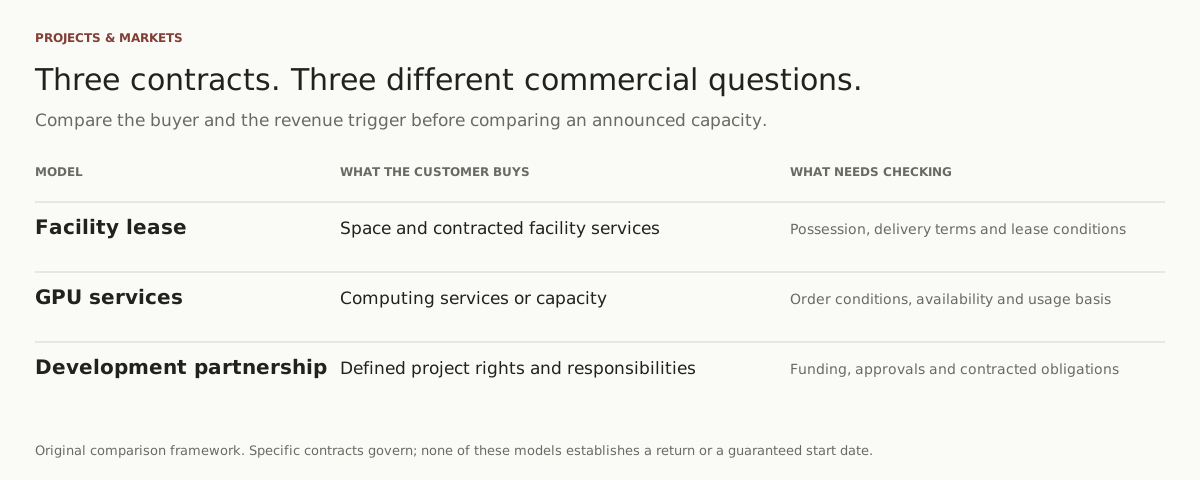
- Facility leaseSpace and contracted facility servicesPossession, delivery terms and lease conditions
- GPU servicesComputing services or capacityOrder conditions, availability and usage basis
- Development partnershipDefined project rights and responsibilitiesFunding, approvals and contracted obligations
Applied Digital and CoreWeave sell different layers
At Polaris Forge 1 in North Dakota, Applied Digital supplies data-center capacity for CoreWeave’s high-performance computing operations. Its July 1, 2026 announcement reported 175 MW live against 400 MW contracted across the campus. The remaining contracted capacity should stay separate from reported operating supply. Applied Digital delivery update
The facility contract creates a landlord–tenant relationship. Applied’s annual filing describes 15-year base leases and says its HPC rental revenue begins when premises are ready for intended use and the tenant takes possession or controls their use. It generally recovers power costs from tenants; tenant fit-out work can generate separate cost-plus revenue. Applied Digital FY2026 filing
The commercial implication is that a facility developer’s contracted megawatts do not measure its tenant’s downstream compute sales. Building expenditure precedes rental income, while equipment procurement and fit-out create another payment stream. A supplier should establish whether its buyer is the landlord, tenant or fit-out contractor. An infrastructure investor needs the revenue-start trigger and remaining construction funding requirement before comparing contracted capacity with cash generation.
Nebius and Meta contract for compute and demand support
Nebius’s March 13, 2026 agreement with Meta covers a different product: GPU capacity with storage and connectivity. Its filing separates $12 billion of dedicated capacity orders, scheduled to begin deployment in early 2027, from an additional order worth up to $15 billion. Under the latter, Nebius intends to sell specified capacity to other customers; Meta must purchase eligible unsold capacity for the remainder of a five-year period from initial deployment. The agreement also includes service commitments and discounted monthly fees for late delivery. Nebius contract disclosure
That structure gives demand support a precise meaning. Meta is both a dedicated-capacity customer and a conditional buyer of otherwise unsold capacity. The headline ceiling is not evidence that all capacity is operating or all revenue has been earned. Delivery, service performance and the specified capacity pool still matter.
Nebius’s August shareholder letter adds a separate cooperation model: partners finance and own AI infrastructure, while Nebius contributes its cloud software, systems architecture and route to customers. This offers a possible entry point for asset owners beyond a conventional facility lease. The letter does not establish that the Meta orders use this model. Any prospective partner still needs the actual hardware-refresh, operating-cost and revenue-sharing terms. Nebius Q2 shareholder letter
Kouvola separates the developer, the user and the backers
In Finland, Kouvola’s municipality identifies a Hyperco–DayOne joint venture as the builder of the Koria data center and TikTok as its intended end user. Its June 2026 planning update anticipated initial operations in early 2027. This is a development-stage facility relationship, with no basis here to classify the workload as a GPU-cloud service. Municipal project update, June timetable
The local delivery chain is concrete: Eltel announced a contract for a 110 kV substation and cabling to Fingrid’s substation. Its announcement scheduled completion of its own work in 2026, which is distinct from the campus’s operating date. Eltel contract announcement
Financing sits at another level. DayOne announced a €500 million mezzanine facility from Brookfield and a sovereign investor, expandable to €1 billion by mutual agreement and secured by its Finland platform. This supports developments including Lahti and Kouvola; it is not a disclosed €1 billion allocation to Kouvola. China-based data-center operator GDS separately reported a roughly 19.9% equity interest in Singapore-headquartered DayOne as of April 29, 2026. That establishes a China-linked capital relationship, without establishing Chinese equipment supply or GDS project control. DayOne financing, GDS ownership disclosure
Make the next conversation specific
For an OCP meeting, bring a transaction description rather than a capacity headline: what you supply, who contracts and pays, which assets you fund, and what evidence releases payment. Compute customers should distinguish usable service from facility readiness. Power and equipment partners should identify the purchasing entity and acceptance scope. Investors should separate tenant credit, compute demand and the security supporting each financing layer.
The next useful connection is the counterparty that can close the missing contract: a tenant, compute buyer, infrastructure owner, grid contractor or capital provider. Naming that gap makes a project discussion actionable.
Figures retain their original reporting dates. Named cases show disclosed roles and arrangements, not verified capacity for sale, a complete capital stack or investment recommendations. The China link is a documented ownership relationship, not evidence of Chinese equipment supply.
Discuss a project or market question · Editorial standards