Saved only in this browser. No account or cross-device sync.
An AI infrastructure proposal can put a large power number beside a commissioning year and leave the most consequential questions unanswered. Where is that power measured? Which project phase can use it? What still has to happen before the first production workload runs?
For developers, operators, suppliers and capital providers comparing projects across markets, “power available” needs a fuller description. A useful starting point is a dated statement: the capacity available at a defined connection point, for a specified operating profile, subject to named conditions. Evidence should support each part.
That is also a more practical way to discuss whether power is bankable. There is no universal checklist that makes a project financeable. But reviewers can identify which delivery assumptions are documented, which remain conditional, and who bears the consequences if they change.
A Virginia event makes the operating question concrete
On 22 July 2026, approximately 3,800 MW of large load unexpectedly transferred off the grid in Virginia. PJM’s August account, drawing on preliminary findings discussed with Dominion, described a transmission-line fault followed by data centers moving to backup generation. Voltage and frequency rose as demand abruptly fell.
PJM reported no significant reliability impacts, and operators acted to restore balance. The event nevertheless prompted examination of interconnection reliability requirements and large-load ride-through practices: how facilities respond to disturbances while remaining connected. The account describes an investigation and standards work, rather than a completed diagnosis or a settled new rule. PJM’s event review
The project-review lesson is straightforward. A supply assessment needs to examine behavior during a disturbance as well as normal consumption. Developers and equipment suppliers should be able to explain the assumptions behind transfer, protection and recovery; operators need to know how those assumptions will be tested. A headline MW figure carries none of that information.
Separate the milestones
“Available” can describe several stages: a preliminary utility discussion, a completed study, an executed agreement, construction progress or an energized connection. A project team should state the actual stage and the remaining dependencies rather than compress them into one label.
Keep the capacity boundary explicit, too. A site's import capacity and the power budget allocated to IT equipment answer different questions. Ask for the reconciliation between them, including the facility loads and design assumptions used. For a phased campus, attach the number and supporting evidence to each phase. Compare that schedule with equipment delivery and customer acceptance: if energization slips, who handles storage, installation changes and delayed acceptance?
The rules governing service also need a date. As checked on 1 October, PJM’s Large Load page labels its Interim Resource Adequacy Service framework “Pending FERC Approval.” PJM describes a path for new large loads bringing new supply and an alternative service level for those without it. That is a live proposal to track, not a basis for assuming approved terms in a specific project. PJM’s current framework and filing links
From a power claim to operating evidence
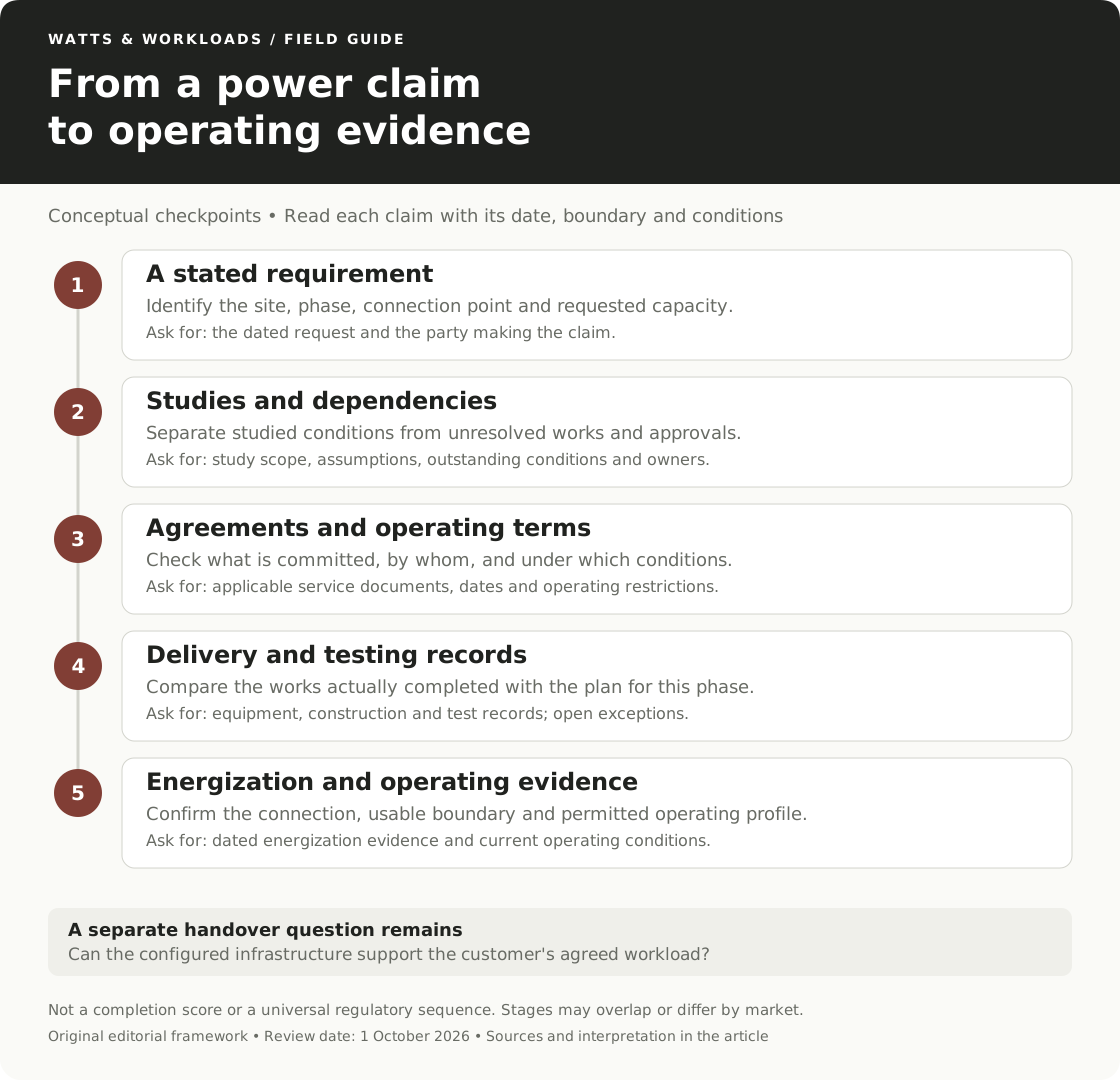
- A stated requirementIdentify the site, phase, connection point and requested capacity.Ask for: the dated request and the party making the claim.
- Studies and dependenciesSeparate studied conditions from unresolved works and approvals.Ask for: study scope, assumptions, outstanding conditions and owners.
- Agreements and operating termsCheck what is committed, by whom, and under which conditions.Ask for: applicable service documents, dates and operating restrictions.
- Delivery and testing recordsCompare the works actually completed with the plan for this phase.Ask for: equipment, construction and test records; open exceptions.
- Energization and operating evidenceConfirm the connection, usable boundary and permitted operating profile.Ask for: dated energization evidence and current operating conditions.
A six-part evidence sheet
The following is an editorial framework for comparing claims, not a substitute for engineering, legal or financing diligence. Every row should carry an evidence owner, document date, unresolved condition and next review date.
| Question | Evidence to request | What the answer clarifies |
|---|---|---|
| Where can the project connect? | Site-control documentation, connection-point identification and relevant access rights | Whether the proposed site and electrical route match the claim |
| Who supplies and authorizes service? | Named counterparties, applicable service documents and study status | Which organization can confirm each obligation |
| How much is usable, and when? | Phase-specific capacity schedule, boundary definitions and commissioning dependencies | The difference between the ultimate campus plan and initial operation |
| Under what conditions? | Documented curtailment, ramping, outage, transfer and restoration provisions | Whether the permitted operating profile fits the intended workload |
| What must still be delivered? | Upgrade scope, equipment milestones, permits and acceptance-test responsibilities | The critical dependencies behind the target date |
| Who carries changes and costs? | Connection and upgrade charges, ongoing service costs, relevant remedies and change provisions | The assumptions requiring contractual or financial review |
An empty cell is useful information. Record “not evidenced” separately from “not required.” A project may be advancing sensibly while a document remains outstanding; the problem is presenting that uncertainty as settled capacity.
What to listen for at OCP
Power architecture creates another set of delivery dependencies. OCP’s Data Center Facility power-distribution group lists a September 2026 release of its LVDC white paper, alongside workstreams covering protection, safety, control and operation. OCP project status
An August OCP article by Google, Microsoft and NVIDIA contributors describes both local conversion beside compute racks and a longer-term direct medium-voltage-AC-to-800-VDC approach. It also identifies continuing work on common interfaces, performance requirements and safety frameworks. These distinctions matter when assessing what a supplier can deliver for a particular facility. OCP’s architecture discussion
NVIDIA’s published OCP schedule includes sessions on curtailable load and interconnection capacity, 800 VDC deployment, and safe system operation. Those are forthcoming sessions, not evidence of results already demonstrated at the summit. NVIDIA’s published programme
For each flexibility claim, ask who can request a reduction, how quickly it must occur, how long it can last and what happens to the workload. For each architecture claim, ask which specification version applies, which components are available and what acceptance evidence the project requires. That turns a conference conversation into a traceable follow-up.
Compare evidence across borders
For teams working between China and international markets, retain the original document name and issuing organization alongside its translation. Ask local advisers to explain its legal and operational effect. Similar English labels should not be assumed to confer identical rights.
The strongest power proposition is one another team can examine: a stated capacity and boundary, a credible milestone sequence, a defined operating envelope, and identified responsibility for the remaining gaps. That is the information needed to move from an attractive site discussion to a decision about delivery.
Source-linked reporting and an editorial framework for project discussions. Technical limits and acceptance procedures belong to the responsible project teams. Event agendas and proposal status can change.
About · Editorial standards · Send a correction or questionFor Chinese readers: 智算通鉴 · 中文相关分析. This is related coverage, not a word-for-word translation.