Saved only in this browser. No account or cross-device sync.
For a Chinese data-center equipment supplier, an overseas opportunity becomes actionable when a particular buyer can approve a particular configuration for a particular site. A broad international catalogue leaves too many decisions unresolved. Start with one country, one equipment family and one buyer group whose procurement process can be investigated.
Identify who specifies the product, who releases the budget, who accepts the installation and who operates it. A developer, systems integrator and colocation operator may participate in the same project while purchasing different scopes. The initial offer should state which scope the supplier is prepared to own.
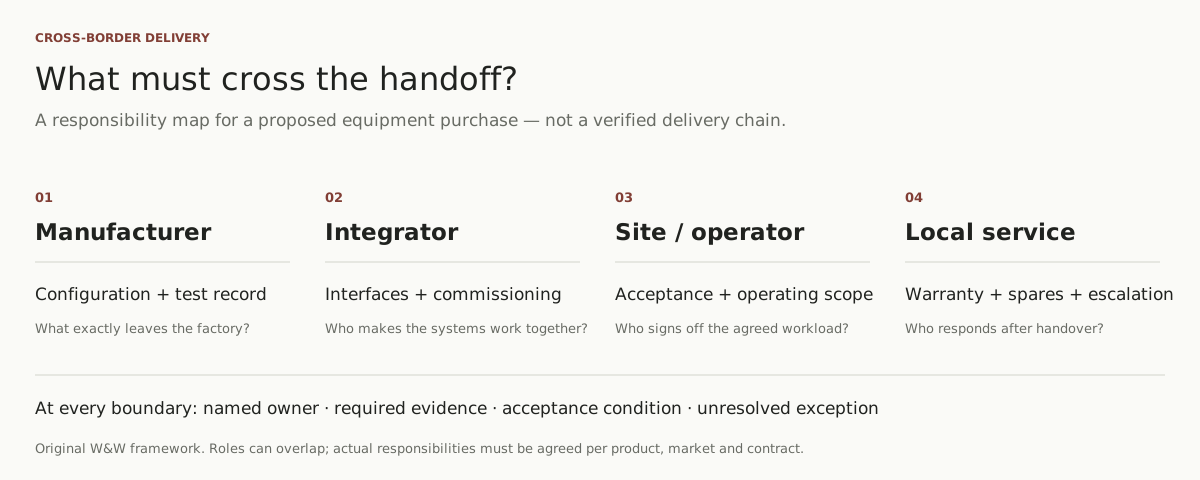
- ManufacturerConfiguration + test recordWhat exactly leaves the factory?
- IntegratorInterfaces + commissioningWho makes the systems work together?
- Site / operatorAcceptance + operating scopeWho signs off the agreed workload?
- Local serviceWarranty + spares + escalationWho responds after handover?
Build the evidence pack before the proposal
For an EU opportunity, map the manufacturer, importer and distributor roles rather than assuming the channel partner will handle everything. Official EU guidance assigns manufacturers conformity and documentation duties and requires importers to verify specified obligations. Resolve instructions, traceability and document availability alongside the commercial arrangement. EU product-compliance responsibilities
Product classification matters. The Commission identifies ecodesign requirements for covered servers and online data-storage products, with exclusions and product-specific provisions. Its current page says Regulation (EU) 2019/424 is under review. Check the applicable text and the proposed configuration instead of treating every data-center product as one category. Commission product guidance
Keep this screening separate from the buyer's technical and security review. Before committing delivery, obtain appropriate advice on destination, counterparty, end use, component-origin restrictions and customer procurement rules. EU guidance should not be generalized to every European or overseas market.
Give the local partner an executable scope
A useful partner assessment asks what the organization will actually do: import, survey the site, install, commission, hold spares, answer alarms or carry warranty labour. Verify resources and customer references for those tasks. Agree authority, escalation, payment and liability before describing the arrangement in a bid.
A manufacturer-published Dubai Airports case offers a concrete illustration. Huawei says the customer, Huawei and partner ALEC prepared for four months before the prefabricated data center arrived after its sea voyage. This historical supplier account illustrates coordinated preparation; it does not establish current market access or a timetable another supplier can reproduce. Huawei's project account
Use the first installation to close specific gaps
A bounded pilot or first order should answer a written set of questions:
- Has the customer approved voltage, frequency, connectors, earthing, protection and controls integration?
- Are rack dimensions, handling weights and cooling connections compatible with the actual site?
- Who owns packaging, transport damage checks, storage conditions and any site assembly or fluid preparation?
- Which factory and site tests establish acceptance, and who signs the results?
- Who pays for retests, replacement transport, site rework and delays attributable to each party?
OCP's liquid-cooling logistics guidance covers transportation, integration, inspections and commissioning. It is a useful reference for defining delivery work, while the selected equipment's limits and the project's approved procedures remain essential. OCP integration and logistics guidance
Make support commercially sustainable
Price the obligations behind the promise: local spares, engineer availability, travel, training, firmware support and returns. Define warranty start, exclusions and labour coverage. Distinguish response time from restoration, and confirm who can authorize replacement without waiting across time zones. An uncosted service commitment can weaken the economics of an otherwise attractive order.
What a paid market-entry brief should resolve
A supplier's international-business or product team may have a reason to fund a country-and-product-specific brief: buyer requirements, evidence gaps, a qualified partner shortlist and first-project cost assumptions. Willingness to pay remains a hypothesis. Test it with a fixed deliverable and decision deadline, keeping research distinct from promised introductions, guaranteed orders or regulatory approval.
Scope: Research checked 1 October 2026. This is a commercial preparation framework, not legal or engineering advice. Requirements and procurement restrictions must be verified for the transaction and destination.
BC Technology business enquiries: share the destination, equipment or resource, stage and next decision. Scope and capability must be agreed before any engagement.
Discuss a requirement or partnership · Editorial standardsChinese reader edition: 海外客户拿到报价后,还需要哪些交付证据. Adapted for Chinese suppliers, not a word-for-word translation.